
The Pursuit of Team Identity
Updated: Jun 11
There is a moment I have witnessed dozens of times over the decades while working with organizations. It happens quietly, usually mid-conversation, when a team suddenly sees itself clearly for the first time. The room shifts, faces soften and something unspoken is finally spoken. I think of it as the wow moment: a group of individuals discovers it has become something more than the sum of its parts.
This moment does not happen by accident. And it cannot be engineered through process design, role clarity, or a well-structured workshop agenda alone. It emerges from a deeper layer of team development - one that, in my experience, remains consistently underestimated, and often entirely absent from how organizations approach change.
I call it the Identity Layer.
And every team journey has its rugged path, its steep climb and its moment of arrival.

Building on 'Group Development Theory' — and Going Further
In 1965 Bruce Tuckman proposed one of the most enduring frameworks in organizational and team development thinking: the four stages of group development: Forming, Storming, Norming, Performing. After decades of working with teams at every level of organizational life, I can confirm: it holds. Teams reliably move through these phases on their development journey, whether they are aware of it or not.
But Tuckman's model, brilliant as it is, describes what happens in a team: behaviors, conflicts, roles, tasks, performance. What it does not address is the question underneath all of it: who are we, together?
This is the dimension I have spent years exploring. The Identity Layer is a parallel thread, running alongside all four of Tuckman's phases. And when consciously tended to, transforms how teams move through each one of them.
1. Forming: A Basket of Separate Identities
When a team is first assembled, it exists on paper before it exists in reality. A group of individuals is brought together for a business reason - to achieve results, deliver a project, lead a function. There is a leader, there are roles, there are timelines. But in practice, teams are rarely assembled from scratch. More often, they evolve - organically, incrementally, sometimes abruptly. A new member joins, someone leaves or a leader changes… and with each of these shifts, the team is no longer quite the same team it was. New dynamics form, old alliances recalibrate and a new Forming begins.
A team consists of identities. Separate, individual, unintegrated identities. Imagine placing different objects into a basket - varied shapes, textures and weights - and expecting them to hold together simply because they share the same container. In Forming, this is precisely what happens. People arrive with their professional histories, their assumptions, their ambitions, and their carefully managed self-presentations. They show their best form. They play the role they believe is expected of them. They are polite, attentive, cooperative - and mainly non-transparent to one another. And with every shift there is a new beginning - a new shape is added to the basket, and the Team Identity Layer re-forms around the new composition.
2. Storming: When the Pretending Stops
As time pressure and performance expectations increase, the careful self-presentation of Forming becomes unsustainable. People stop pretending. They start positioning.
What follows is what Tuckman identified as Storming: conflict, competition, friction. But beneath the surface arguments about responsibilities, priorities, or working methods, something more fundamental is happening. Individual identities are being tested and defended - with their needs, their unspoken agendas and with their fears. People react in the most familiar ways: some become louder, some quieter, some more accommodating than they truly feel. There are sharp words and sudden silences, overreactions and withdrawals.
Teams caught in this phase almost universally make the same mistake: they focus on fixing the symptoms: better processes, clearer responsibilities, strict meeting agendas. These interventions are not wrong, but they work on the surface. They are first aid, but not healing, because the root of the conflict is not structural - it is rather identity-based.
This is where facilitation becomes less about tools and more about atmosphere.
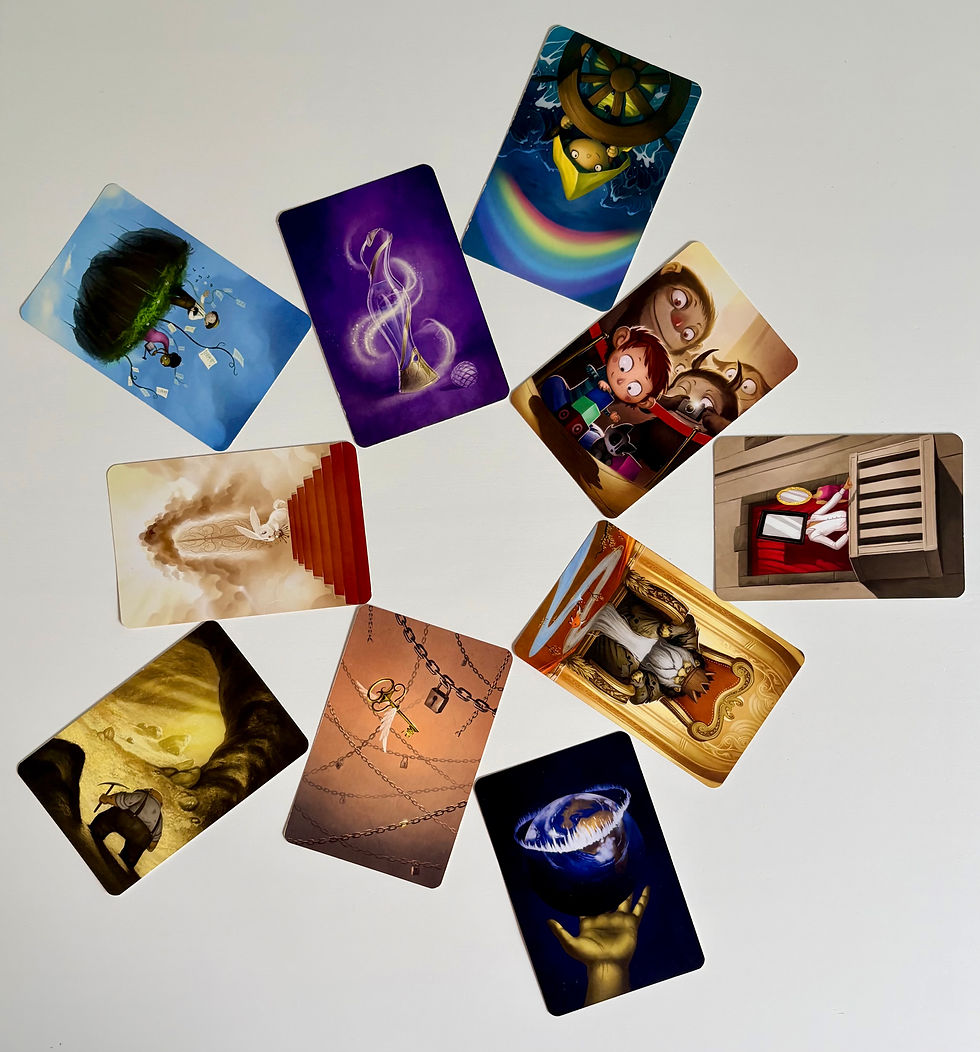
In practice, I often place a set of illustrated metaphor cards on the table and invite each person to simply pick the one that speaks to them right now. No explanation required yet, just a choice of an image.
If the space is safe enough, something remarkable becomes possible: people stop defending and start feeling. When someone says "I feel like a helpless rabbit searching for the key to a locked door" or "I feel like we are navigating a rough ocean" — the room recognizes something true.
Loneliness, fatigue, confusion, anxiety - emotions that have no place in the official corporate vocabulary - come to surface. And when they do, they do not divide the room anymore, but they unite it. The shields come down and hierarchical positions temporarily stop to matter.
Empathy appears. Compassion appears. And then comes realization: others are uncertain too, exhausted too. And this is what begins to dissolve the walls between individual identities. The first invisible threads of genuine connection are forming between the people in the room.
3. Norming: The Identity is Born
When the emotional cards are on the table, a question becomes possible that could not have been asked before:
Who do we want to become together?
In my work, I often invite teams at this stage to look at what they have just expressed - their current experience, their frustrations, their fears - and then project forward. I ask them to describe a future state, with no limitations. Not strategies, action plans or KPIs, but qualities and feelings. Adjectives and nouns.
And what emerges, every single time, follows the same profound pattern. Without coordination or prior agreement, the words on the table converge:
We want to be clear on direction. We want to be integrated. Involved. Supported. Understood. Valued. Recognized. We want to enjoy our work.
The reaction in the room is unmistakable: relief, calm, engagement, energy - and eyes become bright. The realization lands that they want the same things.
This is the moment when team identity crystallizes. Not as a mission statement or a set of company values handed down from above, but as something the team has genuinely discovered about itself. A shared vision. A set of values everyone can claim as their own, because they were present at their creation.
This is the wow moment. And it is always, without exception, earned.
4. Performing: Identity as the Foundation — and the Ongoing Work
From this foundation, performance looks different. Trust is not assumed, it has been built through real vulnerability. Transparency is not a value on a poster, it is a habit formed through practice. When challenges arise - and they always do - the team has a reference point. They have been through something together. The team identity is the anchor.
But one wow moment, powerful as it is, does not complete the work. Teams experience it and that experience is real and lasting - yet everyday pressures have a way of slowly washing it away. Old patterns reassert themselves. The resistance to change is persistent, and it will stretch against even the most genuine breakthrough.
This is why the Identity Layer requires ongoing attention. A regular reflection, small experiments, and reinforced awareness.
The wow moment needs to be consciously revisited: moments of recognition that bring the team back to what they discovered about themselves. Sustained identity is not built in a single session, it is solidified through consistent, reflective practice over time.
The actions become bolder when that practice holds. The collaboration deepens. And the standards the team holds for itself continue to emerge from within, rather than being imposed from without.

The Identity Layer cannot be skipped, substituted or rushed. It requires time, intention, and a willingness to slow down in a world that rewards speed. It requires a leader or an experienced outside facilitator, who is comfortable sitting with discomfort long enough for something real to emerge. And it requires the courage to return, again and again, to the question of who the team is choosing to be.
In my experience, this is the work that changes teams not just for a day, a quarter, but for years. It is also the most beautiful thing I can witness in organizations.


Comments